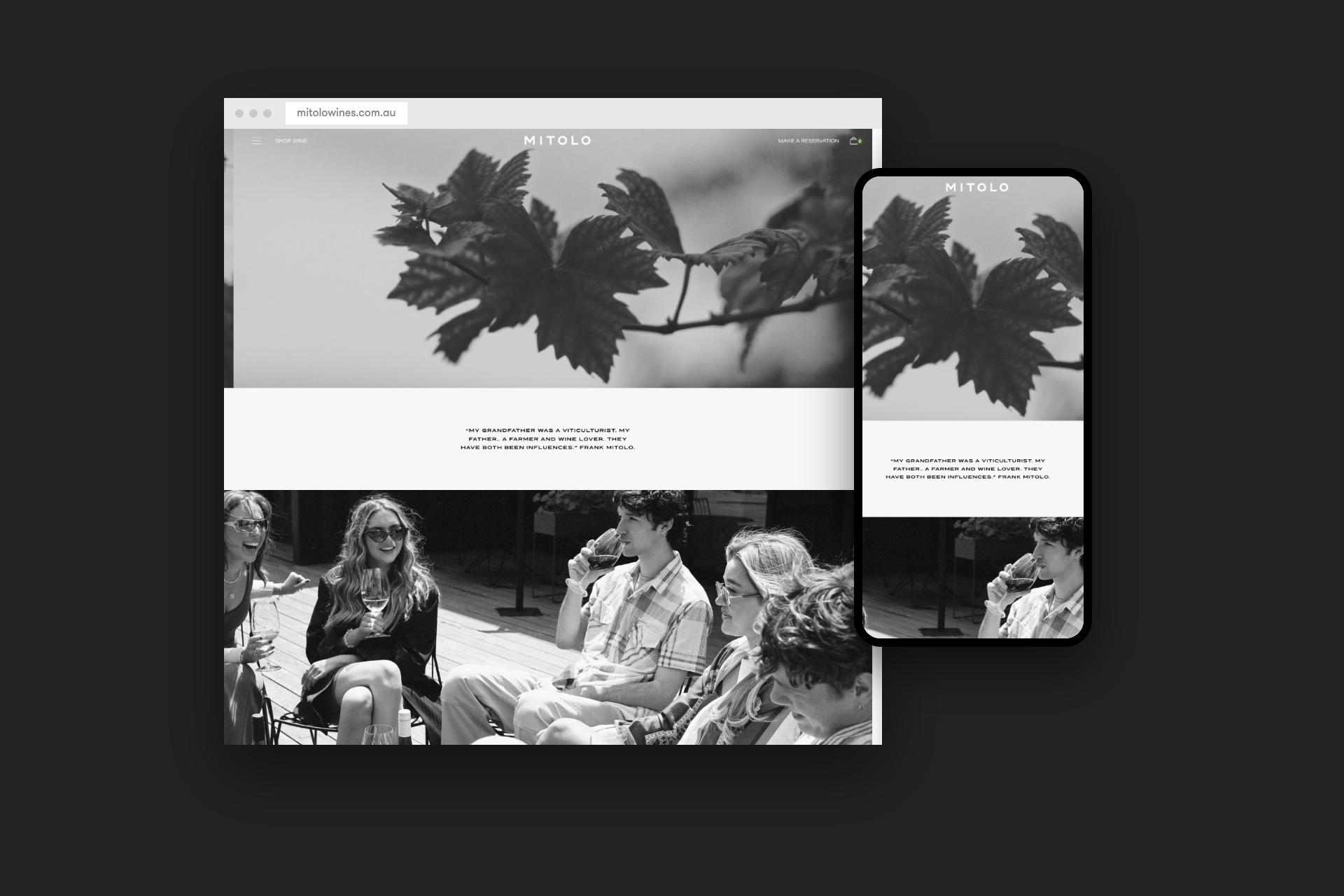

Mitolo Wines needed to move off Shopify without their customers noticing. Today the McLaren Vale winery runs on WordPress with Commerce7 behind it at mitolowines.com.au: the shop, two wine clubs and gift cards in one system, behind the site their customers already knew. Here is how we built it.
Client Overview
Mitolo Wines is a McLaren Vale winery 45 minutes from Adelaide, and rather more than a cellar door. The site carries a tasting venue, two restaurants in Little Wolf Osteria and Frankie Italo Dining, a wedding and events venue, an online store, trade and distribution enquiries, and a wine club running standard and corporate tiers.
That mix is the whole problem. Each of those audiences arrives with a different intention, and all of them have to find what they came for without the site reading like five separate businesses stitched together.
The Challenge
Mitolo came to us in mid 2026 with an online store on Shopify and a brief that was firm on one point: keep the look and feel. They had a premium site their customers already knew, and the rebuild was not an invitation to redesign it.
That set the real constraints:
- Reproduce the existing premium look and feel on new foundations, improving what needed it without the customer noticing the machinery had changed
- Build the new site around Commerce7 as the wine platform, covering the catalogue, customer records, gift cards and checkout
- Present two wine clubs, standard and corporate, with member pricing and museum release access
- Keep the booking systems the venues already ran, rather than replacing working software for the sake of consistency
- Carry the existing content across from Shopify and hold onto the search equity built up on the old URLs
- Serve five different audiences from one site without any of them feeling like an afterthought
Our Approach
We built a custom WordPress theme that reproduces the Mitolo look and feel, with dedicated page templates for the cellar door, both restaurants, weddings, the wine club and the corporate club.
Commerce7 runs the commerce behind it. Products, accounts, cart, memberships, gift cards and checkout are wired into the WordPress front end so the two behave as one experience. Commerce7 was built for wineries, which is the point. The club logic we would otherwise write by hand sits in the platform natively, and members join, manage their own subscriptions and get member pricing inside the site’s own design rather than through a bolted-on portal.
Not everything needed to move. Cellar door and restaurant bookings run on Now Book It, which the venues were already using and which works, so we embedded it into the new templates rather than replacing it. Wedding and event enquiries go through a Tripleseat lead form on the weddings page. The job there was integration, not migration: make software the client already relies on feel like part of one site.
Our side of the platform change was the web content and the URLs. We carried the site content, news and press reviews across from Shopify into the new WordPress build, and mapped 301 redirects from the old Shopify URLs to their new homes so existing rankings and inbound links survived the move. That step gets skipped more often than it should, and it is the reason some replatforms quietly cost a business its search traffic. The Commerce7 data migration itself was handled separately.
Alongside the build we did on-page SEO across pages, categories and product categories, connected Google Analytics and the Meta Pixel, and put the site on Australian hosting we manage, with SSL, hourly and daily backups, malware protection and our standard hardening, where common WordPress paths are renamed so the obvious intrusion routes are not where an attacker expects them.
The Results
Mitolo now runs its cellar door, restaurants, weddings, online store and both wine clubs from one site, with Commerce7 handling the commerce behind a front end that looks like the brand rather than like a platform.
The old Shopify URLs still resolve to the right pages, the booking systems the venues depend on kept working through the change, and the team manages the wine club, the shop and gift cards themselves without needing a developer for routine work. From the customer’s side, nothing about the site announced that the systems underneath had changed, which was the brief.
Key Takeaways
Mitolo is a useful example of a replatform done in the right order:
- Keeping the front end is usually the cheaper decision as well as the safer one. Most replatforming stories go the other way, and customers land on something they do not recognise a week out from a release.
- Club logic belongs in the platform, not in your codebase. Every clever thing built by hand is something the winery owns and maintains forever.
- Keep what is working. A replatform is not a reason to rip out booking software the venue already runs well. Integrating it costs less than replacing it and the staff do not have to relearn their day.
- Redirects are not an afterthought. Mapping the old store URLs is what stops a platform change costing you the search traffic you already had.
- Know which parts of a migration are yours. Splitting the work clearly, content and URLs on one side, commerce data on the other, is what keeps a change of platform from turning into a change of everything at once.
We wrote up the wider comparison behind this decision in WooCommerce or Commerce7 for winery websites, and our winery website design page covers how we approach this work.