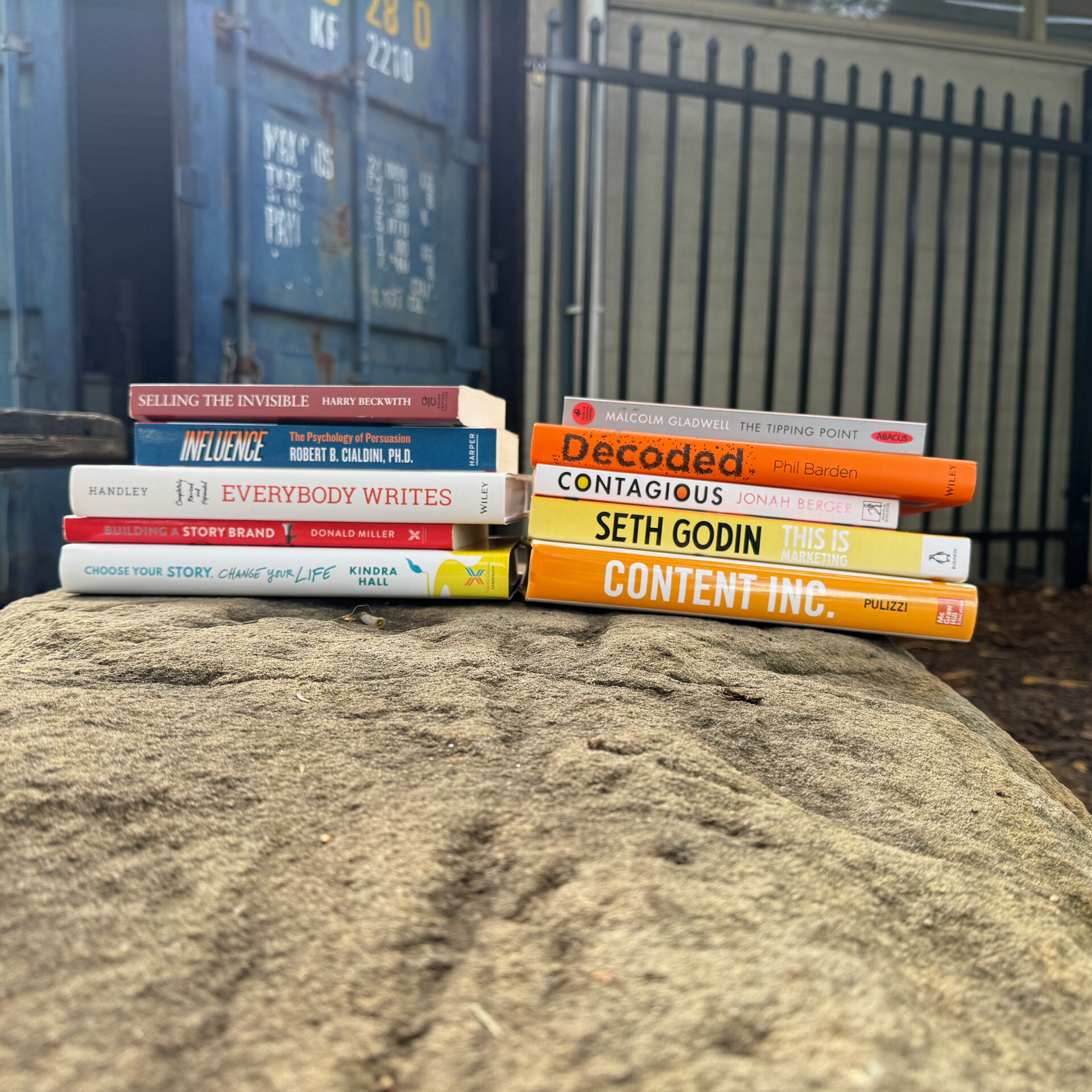
The marketing, writing and persuasion books we keep coming back to in client work, with short summaries of each and what we actually use day-to-day.
We are often asked which marketing books are worth reading and which can be skipped. HyperWeb has been a digital agency since 2000, and across that time we have built up a working library of marketing, writing and persuasion books we draw on regularly when shaping strategy, content programs and client conversations. This page is a curated index of the ones that have most influenced how we think.
It is also a consolidation of dozens of book reviews we have published on this site over the years. Rather than leave them scattered across the blog as single orphaned posts, we have gathered the worthwhile ones in one place, where the surrounding context makes each one more useful.
How these books shape our thinking
The pattern across the books on this list is that strong marketing is built on three durable foundations: genuine understanding of the customer, clear writing that respects the reader, and a deliberate strategy for being remembered. The specific tactics change every few years, but those foundations have not moved in the two decades we have been doing this work. When a client engagement is going well, you can usually find an echo of two or three of these books in the recommendations we are making.
The books are listed alphabetically by author. Each gets a short summary covering the central idea and, where useful, what we have taken from it into client work.
The books
Decoded: The Science Behind Why We Buy, Phil Barden
Barden takes the behavioural economics findings of Daniel Kahneman and others and applies them to marketing decisions specifically. Purchase decisions are made in System 1 (fast, intuitive, emotional) and rationalised in System 2 (slow, deliberate), so effective marketing has to speak to both. We come back to this when shaping value propositions on landing pages: the headline needs to land emotionally before the supporting copy is allowed to argue logically.
Selling the Invisible, Harry Beckwith
The defining book on marketing professional services. Beckwith makes the case that intangible services are bought on trust, clarity and visible care for the client rather than on feature comparison. Most professional-service marketing fails, he argues, because it tries to behave like product marketing. Almost every HyperWeb services page we have ever shipped is informed by Beckwith’s framing.
Contagious: How to Build Word of Mouth in the Digital Age, Jonah Berger
Berger argues that virality is not luck and can be engineered through what he calls the STEPPS framework: Social currency, Triggers, Emotion, Public, Practical value, Stories. Most content does not need to go viral to work, but the lens is useful: a post that earns share-worthy emotion or practical value will outperform an equivalent that does not.
Influence: The Psychology of Persuasion, Robert Cialdini
The foundational text on persuasion: six principles (reciprocity, commitment, social proof, authority, liking, scarcity) that shape why people say yes. It pre-dates the internet by more than a decade and is still one of the highest-leverage books a marketing leader can read. Cialdini’s principles underpin almost every conversion-rate-optimisation choice we make.
Pre-Suasion, Robert Cialdini
The follow-up to Influence, focused on what happens in the moments before an offer or message is delivered. What you put in front of someone immediately before the ask, Cialdini shows, materially shapes their response. This shows up in the way we sequence content on landing pages and in our thinking about ad-to-page flow.
Digital Body Language, Erica Dhawan
Dhawan extends the body-language framing into how people communicate online: when to use which channel, how punctuation and timing carry meaning, where misunderstandings happen most. Useful for thinking about client communication norms and for shaping tone-of-voice guidelines that work across channels.
The Tipping Point, Malcolm Gladwell
Gladwell traces how social epidemics tip when three forces align: the right messengers (Connectors, Mavens, Salespeople), a sticky message and a context that supports it. Most marketing books that came after owe Gladwell something. The “stickiness” frame is the part we use most: a message that is technically correct but not memorable does not move.
Everybody Writes, Ann Handley
The most practical writing book ever published for marketing teams. Handley combines a writing manual with an editorial-standards manifesto for content marketing operations. We recommend it to every client building an in-house content function and use her clarity standards in our own editorial process.
Tao Te Ching, Lao Tzu
An ancient classical text on leadership and the practice of restraint. It belongs on a content and marketing reading list because so much of effective marketing is about what you choose not to say. The Tao Te Ching is one of the oldest written arguments for clarity over noise, and for trusting the reader.
Brief: Make a Bigger Impact by Saying Less, Joseph McCormack
A short, sharp book on concise communication, primarily aimed at executives and consultants. For McCormack, attention is the scarcest resource and brevity is a discipline, not a constraint. Almost every HyperWeb proposal, pitch deck and meeting agenda is shorter because of this book.
Building a StoryBrand, Donald Miller
Miller imports Joseph Campbell’s hero’s-journey framework into B2B marketing and produces a deceptively simple seven-part formula for clarifying brand messaging: customer-as-hero, brand-as-guide, problem, plan, call-to-action, success and failure. Polarising in the industry but undeniably effective at unsticking brand messaging when a client is too close to their own offer.
Oversubscribed, Daniel Priestley
Priestley’s thesis is that successful businesses do not chase demand; they engineer scarcity and create more demand than they can fulfil, which in turn raises pricing power and lowers customer-acquisition cost. The book is more practical than the title suggests and is useful for any service business thinking about positioning and pricing.
The Content Code, Mark Schaefer
Content alone is no longer enough, Schaefer says; ignition, the spread of content through human networks, is what separates effective content marketing from background noise. Useful both as a strategy book and as a check against the common mistake of measuring content by volume rather than by reach.
Content Inc., Joe Pulizzi
The playbook for content-first business building, drawn from Pulizzi’s experience launching the Content Marketing Institute. Build the audience before you build the product, and the audience itself becomes the most defensible asset the business owns. For HyperWeb’s GEO thinking, Pulizzi’s audience-first framing is foundational.
The Conversion Code, Chris Smith
A tactical sales-and-marketing playbook from a real-estate-tech operator. Smith covers lead capture, follow-up cadences, scripts and the day-to-day mechanics of converting digital traffic into bookings. The principles transfer well to any service business with a high-consideration purchase.
This Is Marketing, Seth Godin
Godin’s distillation of decades of marketing thinking into a short, philosophical manifesto: marketing as the practice of solving problems for the smallest viable audience whose lives you can genuinely improve. It reorients teams that have started measuring the wrong things.
Choose Your Story, Change Your Life, Kindra Hall
Hall works from a simple premise: the stories people tell themselves about themselves shape what they accept as possible, in business and in life. Crosses the line from marketing book into personal-development territory, but the underlying mechanic about story as identity is useful when shaping brand narratives that survive growth.
UnMarketing, Scott Stratten
Stratten’s case against the manipulation-flavoured marketing tactics that proliferated in the early 2010s, and an argument for relationship-first marketing instead. Some of the specific tactical advice has dated, but the central argument about trust and consistency has aged well.
What we use from these books day-to-day at HyperWeb
Several patterns show up across the list and turn up regularly in our client work.
System 1 first, System 2 second. That one comes from Barden, via Kahneman. Landing-page hero copy has to land emotionally before the supporting copy is allowed to argue logically. We catch a lot of nearly-finished pages that have inverted the order.
Smallest viable audience. Pure Godin. Most underperforming positioning is too generic for everyone. Our scoping conversations push toward who specifically the offer is for, even when the client resists narrowing.
Clarity is the conversion lever. Handley, McCormack and Miller all arrive at this point from different directions. Most websites under-convert because the value proposition is unclear, not because the design is weak. We default to fixing copy before we discuss visual treatment.
Persuasion is structured, not improvised. Cialdini’s fingerprints are on every conversion-focused page we ship: social proof, scarcity, authority and reciprocity, deliberately and in measured proportion.
Stickiness over volume. Gladwell and Schaefer converge on this one. Memorable beats frequent. We will choose one well-shaped post per month over four forgettable ones every time.
Frequently Asked Questions
What is the single best marketing book for a business owner who has only time to read one?
For a business owner running a service business, Selling the Invisible by Harry Beckwith. For an ecommerce or product business, This Is Marketing by Seth Godin. Both are short, both are practical and both are written to be re-read every few years.
Which book on this list is most useful for thinking about AI search and GEO?
Content Inc. by Joe Pulizzi. Pulizzi’s audience-first argument predates AI search but maps onto it well: a business that has built genuine topical authority through consistent, high-quality content earns visibility in AI-generated answers in the same way it earned visibility in organic search. The mechanism has changed; the principle has not.
Why include the Tao Te Ching on a marketing reading list?
Because most marketing problems are restraint problems. Too much copy, too many calls to action, too many channels. The Tao Te Ching is one of the oldest written arguments for saying less and trusting the reader to fill in the gap. It is also a leadership text, but the marketing reading is the part that matters here.
Which books on this list should I skip?
None of them, because we have already done the filtering for you by including only the ones we still draw on. If pressed, the books most worth re-reading in 2026 are Beckwith, Godin, Cialdini and Handley. The rest reward a single attentive read.
Want help putting the thinking from these books into practice?
HyperWeb has worked with Newcastle and Hunter region businesses on website strategy, content programs and digital marketing since 2000. If you would like to talk through how this thinking applies to your business, get in touch with the team.
This list is one of three on the blog; the creativity, technology and innovation books have their own page. If you would prefer to start with one of our deeper resource posts on content and marketing strategy, our guides on why business blogging still matters, auditing and refreshing website content and building a local marketing strategy are practical starting points.