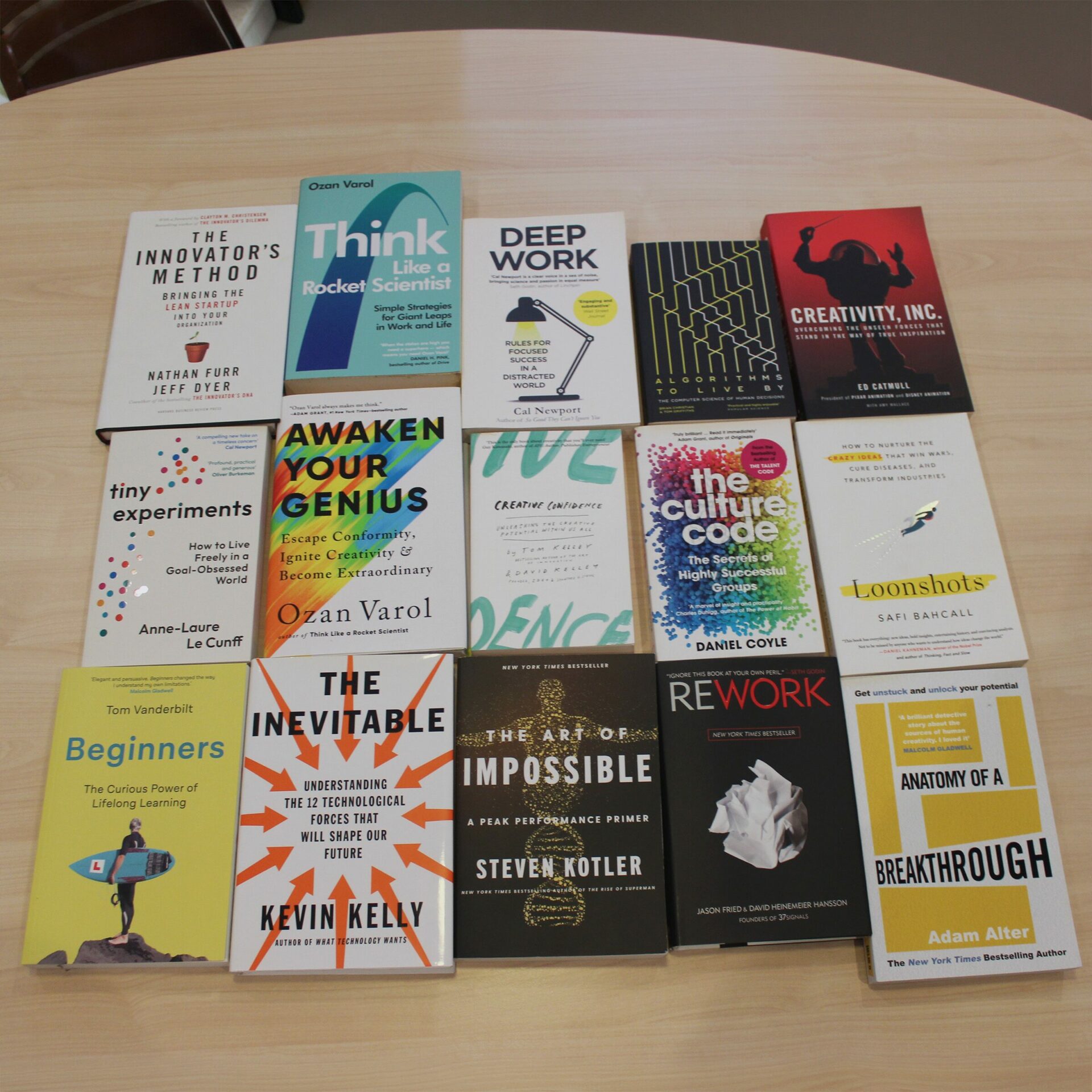
The creativity, innovation and technology books we keep coming back to at HyperWeb, with short summaries and what we use from each.
Running a digital agency for 25 years teaches you fast that the work changes about every two years. The platforms keep changing. So does the tooling, and so do the questions clients ask. The books on this page are the ones that have helped us stay useful through those shifts, mostly by changing how we think rather than what we do. They cover creative practice, applied innovation, the long view of technology, deep work, and what it actually takes to produce original output inside a working business.
This is a consolidation of the book reviews we have published on these themes over the years. Rather than leave them scattered across the blog, we have pulled the worthwhile ones together so the thinking is easier to find.
How these books shape our thinking
A few ideas turn up again and again. Thinking from first principles. Treating work as small experiments rather than one big bet. Protecting attention so deep work can actually happen. Watching the long arc of technology so the next ten years do not catch you out. The specific tools change every couple of years, but those underlying habits keep holding up.
Books are listed alphabetically by author. Each entry has a short summary, plus the part we still use.
The books
Anatomy of a Breakthrough, Adam Alter
Alter looks at why creative or strategic projects get stuck and what unsticks them. The research pulls from sport, science and the arts, and the central argument is that breakthroughs are more about removing friction than about inspiration striking. We open this one when a client project, or one of our own, has obviously stalled and we cannot put a finger on why.
Loonshots, Safi Bahcall
Bahcall argues that real innovation comes from keeping early-stage “loonshot” teams structurally separate from the operational “franchise” teams that run a business. Most companies mix the two and lose the loonshots in the process. A good frame to read before you try to incubate a new offer inside an existing company.
Creativity, Inc, Ed Catmull
Catmull on building Pixar, including the practices that let it produce hit after hit when most studios produce roughly one. His underlying point is that originality is fragile and has to be defended on purpose, through specific cultural and structural choices. If we had to recommend one book on leading a creative business, it would probably be this one.
Algorithms to Live By, Brian Christian and Tom Griffiths
Christian and Griffiths take computer-science algorithms (sorting, scheduling, the secretary problem, optimal stopping) and apply them to everyday decisions. The payoff lands a few weeks after you read it. You start noticing the structural shape of decisions you previously handled by gut feel.
The Culture Code, Daniel Coyle
Coyle’s research on what high-performing teams have in common. Three things: safety, vulnerability, a clear shared purpose. Reads well next to Catmull. What makes this one stand out is how specifically Coyle identifies the small behaviours that produce each of those outcomes.
The Circle, Dave Eggers
Eggers’s dystopian novel about a thinly disguised tech-platform monopoly that ends up running an authoritarian transparency regime. Not a business book. On this list because it is one of the better fictional warnings about where the platform-everything direction leads, and the conversations it triggers about user data and platform power have aged surprisingly well.
Rework, Jason Fried and David Heinemeier Hansson
The Basecamp founders pushing back against most of the accepted wisdom about how software companies operate. Planning is guessing. ASAP is poison. Meetings are toxic. Some of the contrarianism has aged unevenly, but the underlying case for a calm, profitable, smaller-by-design business is one we have actively used at HyperWeb.
Innovation Thinking Methods for the Modern Entrepreneur, Osama Hashmi
Hashmi runs through the main innovation frameworks an early-stage founder is likely to encounter: design thinking, jobs-to-be-done, lean startup, the business-model canvas. Treat it as an index rather than a deep read. Worth shelving so you can pull the specific framework when you need it.
Where Good Ideas Come From, Steven Johnson
Johnson argues that new ideas come from “adjacent possible” combinations of existing components, from slow hunches that compound over years, and from networks designed to allow serendipitous collisions. This one changed how we think about content programs. We now treat a content strategy as a network of ideas rather than a list of posts.
Creative Confidence, Tom Kelley and David Kelley
The IDEO founders make the case that creative ability is built, not innate, and that most adults have lost it through schooling rather than because they never had it. Reads well with Catmull and Coyle for any team trying to rebuild the daily habit of generating ideas.
Inevitable, Kevin Kelly
Kelly’s case that twelve technological forces (becoming, cognifying, flowing, screening, accessing, sharing, filtering, remixing, interacting, tracking, questioning and beginning) will shape the next thirty years more than any specific product or company. Written in 2016 and aging surprisingly well. His “cognifying” chapter described what we now call the AI moment without naming it as AI.
The Art of Impossible, Steven Kotler
Kotler distils peak-performance research from extreme-sport athletes and translates it into principles for ordinary knowledge work. Reads as a companion to Csikszentmihalyi’s Flow over in Hub B. Practical if you are interested in optimising for difficult creative output rather than just steady output.
Tiny Experiments, Anne-Laure Le Cunff
Le Cunff argues for treating life and work as a series of small, time-boxed experiments rather than a single linear plan. Anyone whose business has outgrown its founding plan finds this framing useful, often quickly. The “PACT” framework (purposeful, actionable, continuous, trackable) does the day-to-day work of converting the philosophy into something operational.
Deep Work, Cal Newport
Newport argues that deep work, cognitively demanding work done in long uninterrupted blocks, is the scarcest and most valuable capability in the knowledge economy. The specific examples in the book have dated, since the post-COVID attention economy turned out rougher than Newport modelled. The underlying argument has only become more important.
Beginners, Tom Vanderbilt
Vanderbilt takes up new skills in middle age: chess, surfing, singing, drawing. He writes about what the experience taught him about learning, identity and the underrated value of being a beginner. Useful for any leader who has not been visibly bad at something in front of other people for a long time.
Think Like a Rocket Scientist, Ozan Varol
The earlier of the two Varol books on this list. His case is that original work in any field tends to follow the same methodological discipline rocket scientists use: question assumptions, run thought experiments, accept uncertainty rather than wishing it away. The title undersells the writing.
Awaken Your Genius, Ozan Varol
Varol’s follow-up. Narrower in scope, more personal. The argument is that genuine originality requires going back and rediscovering the version of yourself that existed before professional shaping, and that most adults have lost that version without noticing. Reads as a companion to Think Like a Rocket Scientist.
The Innovator’s Method, Jeffrey H. Dyer and Nathan Furr
Dyer and Furr argue that design-thinking and lean-startup methods belong inside established companies, not just startups. Read it after The Innovator’s Dilemma if you are working through Christensen and want a practical follow-up.
What we use from these books day-to-day at HyperWeb
Several patterns recur across this list and turn up in our client work.
Treat work as experiments, not bets. Le Cunff, the Kelleys and Edmondson (over in Hub B) all land on this. The clients of ours who run the best content and product programs treat each piece as a small bet whose result feeds the next decision, rather than as a single large investment they need to defend.
Read the long arc, not the news cycle. Kelly is the strongest voice on this. The underlying technological trends that compound over a decade end up mattering more than the announcements that fill any given week. We still use Kelly’s “cognifying” frame when we are talking to clients about AI.
Protect attention deliberately. Newport, Csikszentmihalyi and Eyal (both in Hub B) keep coming back to the same point. The teams that ship original work tend to have a few hours of uninterrupted, cognitively demanding work in their day. The teams that recycle do not.
Build for original output, not for activity. Catmull, Coyle, Bahcall and the Kelleys all keep circling this. Creative cultures that produce work the market notices have specific structural features: separation of loonshot and franchise work, psychological safety, vulnerability, clarity of shared purpose. None of that is accidental.
Frequently Asked Questions
Which book on this list is most useful for thinking about AI and the next decade of digital?
Inevitable by Kevin Kelly. Written in 2016 and still the best long-arc book on the underlying technology forces (cognifying, flowing, accessing, tracking) that have produced the AI search moment, and that will likely produce the next one. We re-read it about every two years.
Which of these books is most useful for an agency or studio owner?
Creativity, Inc by Ed Catmull, every time. Catmull’s account of how Pixar built a culture that could produce original hit work over and over again is about as close to a working manual for a creative business as we have seen in print.
Are there books here for a non-technical reader?
Yes. Beginners by Tom Vanderbilt, Tiny Experiments by Anne-Laure Le Cunff and Awaken Your Genius by Ozan Varol are written for general readers and require no technical background.
Which book on this list pairs best with HyperWeb’s GEO content pillar?
Inevitable by Kevin Kelly. The forces Kelly names (cognifying, flowing, filtering, interacting) describe the conditions under which AI search emerged. Reading him gives you the long-arc context the discipline of optimising for AI engines is built on.
Want help putting the thinking from these books into practice?
HyperWeb has worked with Newcastle and Hunter region businesses on website strategy, content programs, digital marketing and AI integration since 2000. If you want to talk through how the thinking on this page applies to your business, get in touch with the team.
If you want to read further around the same themes, our pieces on AEO and GEO, our AI integration work and assessing online competitive position are good places to start.