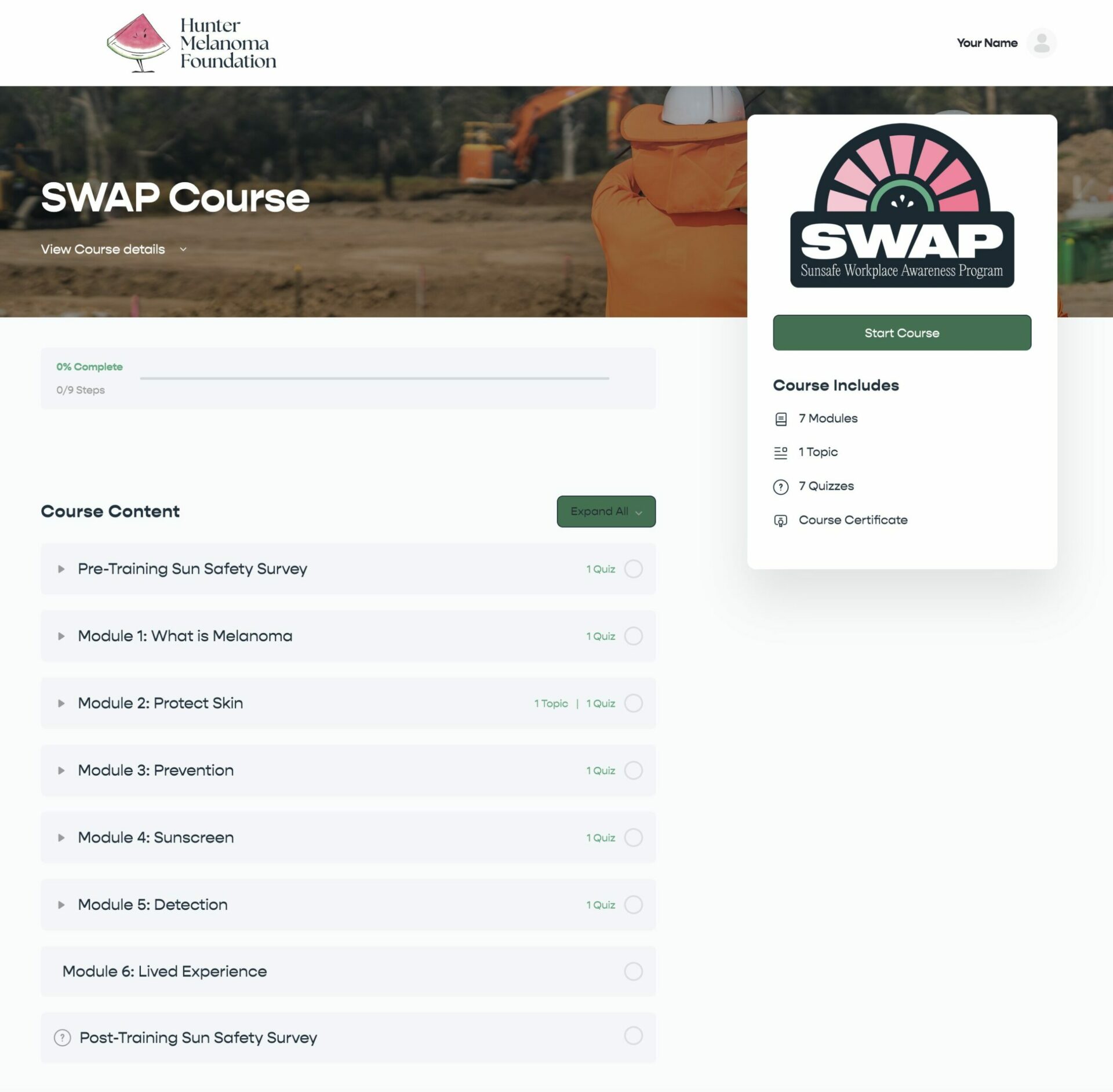
Somewhere in the Hunter right now, a worker is sitting in a site shed with a phone, finishing a sun-safety course. When the final assessment is done, a certificate with their name on it lands on that phone, their employer’s training record updates itself, and nobody at the charity that runs the program lifts a finger.
That last part is the point of this post.
Most businesses think of their website as a description of what they do. Services, team, testimonials, contact form. That model is so common we barely notice it, and for plenty of organisations it’s enough. But it quietly sets a ceiling: the website tells people about your work, and then humans do all of the actual work behind the scenes.
The platform we recently built for the Hunter Melanoma Foundation breaks that model, and it’s a useful case study in what becomes possible when you stop asking “does our website describe us well?” and start asking “what could our website actually do for us?”
A mission bigger than the headcount
The Hunter Melanoma Foundation is a registered charity working to reduce the impact of melanoma in a country with some of the highest skin cancer rates in the world. Its SWAP program, the Sun Safe Workplace Awareness Program, targets the people who carry a disproportionate share of that risk: outdoor workers. Construction crews, landscapers, road workers, trades. People whose workplace is the sun.
SWAP had been delivered in person, and it worked. But in-person delivery has a hard limit: the size of the team delivering it. The Foundation is a small charity, and the number of workplaces that need this training is enormous. Every hour spent on scheduling, paperwork and certificates was an hour not spent reaching another workplace.
The mission was bigger than the headcount. That gap is exactly what a well-built web application is for.
Not videos on a webpage
It would have been easy to treat this as a content problem: record the training, put it behind a login, done. That version gets built a lot, and it fails a lot, because delivering a real training program requires much more than hosting videos.
The Foundation needed structured courses with lessons, assessments, learner accounts and progress tracking. It needed provable completion: personalised certificates for workers and reliable records for employers, because this is workplace safety training, not casual viewing. It needed payment flexibility for everyone from a sole trader booking one course to a large employer enrolling a whole workforce. And it needed all of that to run without manual administration, because a small charity team can’t spend its week re-keying enrolment data.
One more constraint shaped everything: the audience. Outdoor workers don’t complete training at a desk. The platform had to work on a phone, in a work vehicle or a site shed, on patchy regional internet.
What we built
The SWAP training platform now lives at training.hmf.org.au, a dedicated learning management system built on the LearnDash and BuddyBoss stack within WordPress. It carries the Foundation’s brand while standing visually distinct as its training arm. In practical terms, here’s what it does:
- Delivers the courses. Structured lessons and assessments, learner dashboards, and password-protected resources like toolbox talks and workplace checklists. New courses can be added as the program grows.
- Takes the money. Stripe payments supporting one-off purchases, subscriptions, discount coupons, free courses and custom packages for larger organisations, all managed by the Foundation’s team without a developer in sight.
- Proves the training happened. Completing the final assessment generates a PDF certificate personalised with the learner’s name, downloadable on the spot and emailed automatically. Employers can run reports by course, learner or group and see exactly where their team is up to.
- Talks to the Foundation’s systems. Integrations with Zoho CRM and Xero mean enrolments, payments and contact records flow through automatically, with email notifications keeping administrators and learners informed.
Underneath all of that sits the unglamorous work that makes a platform trustworthy: security hardening around user accounts and payments, speed optimisation, responsive development, and on-page SEO from day one. We finished with hands-on training for the Foundation’s team at their Waratah premises, because a platform you can’t run yourself is a liability, not an asset.
The number that matters is zero
Here’s the outcome I keep coming back to. When a new business enrols its team in SWAP today, the administrative cost to the Foundation is zero. No forms to process, no certificates to create, no records to update, no invoices to chase into the accounting system. The platform does all of it.
That’s what lets a small charity operate with the reach of a much larger training organisation. Scale didn’t come from hiring; it came from removing the administration between the Foundation and every workplace it serves.
“Working with Brendan and the Hyperweb team has been an excellent experience. They’ve consistently demonstrated creativity in responding to our requests and have been timely and reliable in all communication. The result is a high-quality product in the SWAP training platform, which reflects their skill, professionalism, and commitment to delivering great work.”
Sue-Ellen Evans, Project Manager, Hunter Melanoma Foundation
You can read the full project breakdown in our SWAP training platform case study.
What this means for your organisation
You may not run a sun-safety charity, but the underlying question travels well: what work is your team doing by hand that your website could be doing for you?
If you deliver training, the answer might look like SWAP. But the same pattern applies to membership content, certification and compliance, client onboarding, bookings and recurring billing, gated resources, or reporting that customers currently have to email you for. In each case the shift is the same: from a website that describes the service to a web application that performs it.
A few tests we would apply to your situation, based on this build:
- Is the process repeatable? If you run the same sequence for every customer (enrol, deliver, certify, record), that sequence can almost certainly be systematised.
- Is admin the bottleneck? If growth means proportionally more paperwork, automation changes your economics, not just your convenience.
- Does proof matter? Where completion, compliance or membership status must be provable, automating the record-keeping is worth more than automating the delivery.
- Can your team run it without us? A purpose-built platform should end with handover, not dependence. If a proposal keeps the developer permanently in the loop for daily operations, question it.
To be clear, this isn’t an argument that every business needs a web application, and it isn’t an AI story either; SWAP is a learning platform, built on proven tools, doing structured work reliably. Some organisations genuinely need a well-crafted brochure site that tells the right story, and nothing more. The mistake is never asking the question, or assuming the answer requires enterprise budgets. It doesn’t.
Frequently asked questions
What is the difference between a website and a web application?
A website presents information about your organisation. A web application performs work: it handles accounts, payments, content delivery, records and reporting. The SWAP training platform is a web application, delivering an entire training program without manual administration.
How do you deliver online training with certificates from a WordPress website?
A learning management system built on WordPress with LearnDash and BuddyBoss can deliver structured courses, assessments, learner accounts and progress tracking, generate personalised PDF certificates automatically, and take payment through Stripe, including subscriptions and organisation packages.
How much does a custom learning platform cost to run day to day?
Built correctly, very little. Automating enrolments, certificates, notifications and CRM and accounting integration means each new learner adds no administrative workload. The Hunter Melanoma Foundation team runs the SWAP platform themselves, without developer involvement.
Start with the program, not the platform
The SWAP build worked because we started with the program: who the learners are, where they train, what employers need to prove, what the Foundation’s team could sustain. The technology choices followed from those answers, not the other way around.
If your organisation delivers training, membership content or certification, and the administration is holding back the mission, we should talk. Book a free initial consultation with the HyperWeb team, or browse more of our case studies to see what purpose-built looks like in practice.
By Brendan Brooks, Founder and Managing Director of HyperWeb. Brendan has spent 25 years helping organisations turn their websites into working parts of the business rather than separate islands.