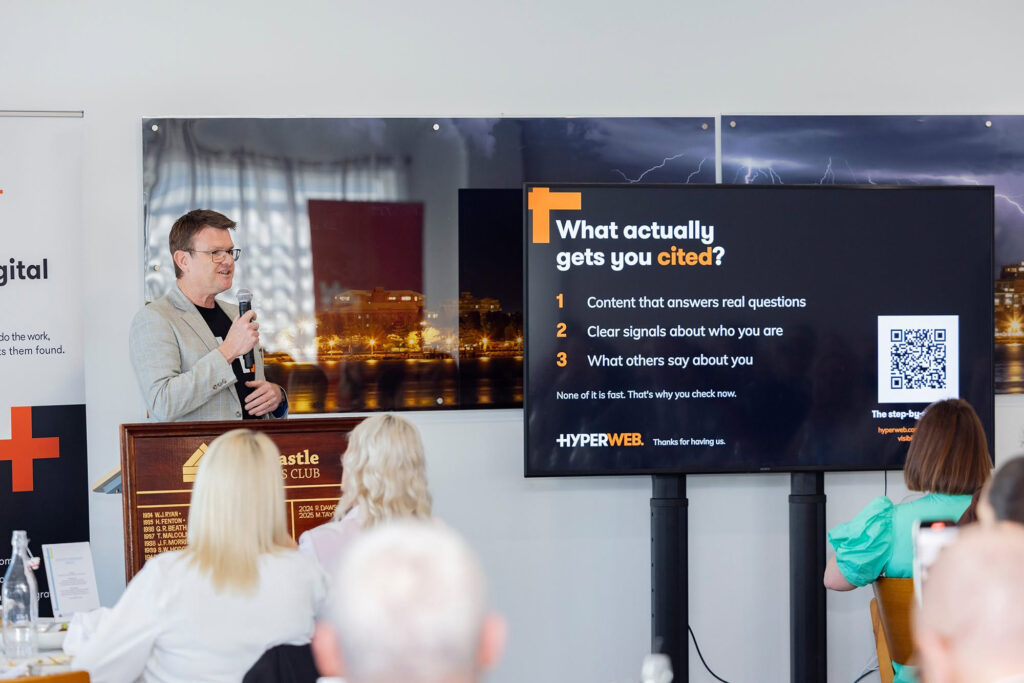
If you’ve ever asked ChatGPT to recommend a business like yours and watched it name three competitors and not you, here’s the short version of why: AI search engines can only mention businesses they can find, understand and trust. If you’re invisible in AI answers, it’s almost always because your website falls down on one of those three. The good news is that all three are fixable, and the fixes are the same disciplined work that’s always made a website findable, just aimed at a new kind of reader.
More of your customers are starting with AI than you think. Instead of Googling “web designer near me” and scanning a page of results, they ask ChatGPT, Perplexity or Google’s AI Mode a full question and take the shortlist it gives them. If your business isn’t on that shortlist, you’re losing the enquiry before you ever knew it existed. We’ve watched it happen to businesses that have ranked on Google’s first page for years: they ask an AI engine the question their customers ask, and it recommends a handful of competitors without ever mentioning them. This is the same shift we wrote about in our working guide to GEO and AEO, looked at from the angle that matters most to a business owner: why am I not there, and what do I do about it?
How does AI search decide who to mention?
It helps to understand what’s happening under the hood, because it explains every fix that follows.
An AI engine answers a question in two steps. First it draws on what it absorbed during training, a broad sense of which businesses are known and credible in a field. Then, for anything current, it fetches live pages from the web, reads them, and lifts the parts that answer the question. To be named, you need to either be a brand the model already recognises, or have a page it can fetch and understand well enough to quote. Ideally both.
That’s the whole game. Everything below is about making your business one of the brands the model knows, and your pages the ones it can lift a clean answer from.
What are the real reasons your business is invisible?
In our experience there are five, and most businesses have more than one.
1. Your content doesn’t answer questions directly. AI engines lift short, self-contained answers. A page that buries its point under five paragraphs of preamble, or never states the answer plainly, gives the engine nothing to quote. Pages that lead with a clear answer and back it up get cited. If your content reads like a brochure rather than an answer, it’ll be skipped.
2. Your business isn’t a clear entity. AI engines build a picture of who you are from your name, address, phone number and description as they appear across your website, Google Business Profile, LinkedIn, directories and data aggregators. When those details are inconsistent, or barely present, the engine can’t form a confident picture of your business, so it plays safe and names someone clearer. We go deeper on this in entity SEO, but the short version is: be the same business everywhere, in exact detail.
3. You have little or no schema markup. Schema is structured data that spells out, in a format machines read directly, what your page is and which sentence answers which question. Most businesses treat it as an optional plugin setting. AI engines and search engines use it to confirm what they’re looking at. Without it, you’re asking the machine to guess. Our piece on schema markup covers what actually matters here.
4. You’re accidentally blocking the AI crawlers. AI engines send their own bots to read your site: GPTBot, OAI-SearchBot, ClaudeBot, PerplexityBot and others. If your site blocks them, whether by choice or by a setting nobody remembers changing, you remove yourself from AI answers entirely. It’s worth checking, and we explain the decision in GPTBot and your website.
5. You haven’t earned enough authority. AI engines lean toward businesses that appear credibly and repeatedly across the web: mentions, links, reviews, coverage. If your business barely shows up beyond its own website, the model has little reason to trust you over a competitor who’s cited everywhere. This is the slowest to fix, but it compounds.
How do you check where you actually stand?
Before fixing anything, find out how invisible you really are. Ask ChatGPT, Perplexity and Google’s AI Mode the questions your customers would ask: “best [your service] in [your town]”, “who should I hire to [do the thing you do]”. See whether you’re named, and who’s named instead. We wrote a full method for this in how to check where you really stand. Do it logged out, so you’re seeing what a stranger sees, not a result skewed by your own history.
We run this check on our own business, and it keeps us honest. One recent morning we asked three engines the same simple question, who are the best web developers in Newcastle. ChatGPT put us first. Perplexity and Google’s AI Mode didn’t mention us at all, even though we’ve ranked on Google’s first page for our own services for years. Same question, same day, three completely different answers. That’s the nature of these engines: being named by one is no guarantee with the next, and the answers shift over time, which is why one check is a snapshot, not a scoreboard.
Whatever comes back is your baseline. If competitors are named and you’re not, the five reasons above are your checklist.
How do you fix it?
The work sorts into quick wins and slow burns. Do the quick ones first.
Fix your business information everywhere. Make your name, address and phone number identical across your website, Google Business Profile and every directory you can find. It’s unglamorous, and it’s the single highest-return thing most local businesses can do, because it feeds the entity picture directly.
Rewrite your key pages to answer questions. On the pages that matter, lead with a direct answer, then support it. Add an FAQ section that answers the real questions customers ask. This helps human readers and gives AI engines clean passages to lift.
Add proper schema markup. Organization, LocalBusiness, Service and FAQPage schema on the relevant pages. It’s technical work, but it’s a one-time setup that keeps paying off.
Confirm the AI bots can reach you. Check your robots file and any security or firewall settings aren’t quietly blocking the AI crawlers you want reading your site.
Build authority over time. Publish genuinely useful content on your topic, earn mentions and reviews, and get listed where your industry gets listed. This is the long game, and it’s the difference between being occasionally fetched and being a brand the model knows.
Why is this a technical job, not a magic trick?
Plenty of people are already selling “get your business into ChatGPT” as if it were a switch. It’s not. Appearing in AI search is the product of clean structure, consistent data, real schema, open access for the right crawlers, and earned authority. That’s disciplined web and content work, which is exactly what a good web team does. If a service promises instant AI visibility with no changes to your site, it’s selling you something that doesn’t exist.
None of this is beyond a small business. It’s the same fundamentals that have always made a site findable, pointed at a new reader. The businesses that do it now, while most are still working it out, are the ones AI engines will name for the next few years.
Frequently asked questions
Why does ChatGPT recommend my competitors but not me?
Usually because your competitors are easier for the AI to find, understand and trust. Their business information is consistent across the web, their pages answer questions in a liftable way, they have schema markup, they allow the AI crawlers, and they’re mentioned in more places. Any one of those gaps can be enough for the engine to name them and skip you. The fixes are the same disciplined web and content work that makes any site findable.
How do I get my business to show up in AI search?
Start by making your business information identical everywhere (website, Google Business Profile, directories), rewrite your key pages to answer real customer questions directly, add proper schema markup, confirm you’re not blocking the AI crawlers, and build authority over time through useful content and mentions. Check your starting point first by asking AI engines the questions your customers would ask, logged out.
Is appearing in AI search different from ranking on Google?
They overlap heavily. AI engines draw on much of the same web Google indexes and reward the same signals: clear content, consistent business data, strong schema and real authority. The difference is the finish line. Google shows a list of links; AI search lifts an answer and names a source. Work that improves one generally improves the other.
Can I pay to be included in ChatGPT or AI answers?
No. There’s no paid placement in the organic answers ChatGPT, Perplexity or Google’s AI Mode generate. Being named is earned through the visibility, structure and authority of your business online. Anyone promising guaranteed paid inclusion in AI answers is misrepresenting how these engines work.
Want a straight answer on where you stand?
HyperWeb has built websites and digital strategies for Newcastle and Hunter businesses since 2000, and getting our clients found in AI search is now part of that work. If you’d like us to check where your business currently stands in AI search and what it’d take to fix it, get in touch with the team. For the full picture, our guide to GEO and AEO is the place to start.