Most of the AI conversations I’ve had lately land in one of two buckets. The first is about being found. The second is about the work itself. They’re different problems with different fixes, and nearly every business I talk to has both. So we’ve put together an AI readiness review that covers the pair of them.
Here’s what sits in each bucket, and how you’d check your own position on either.
Why do businesses on page 1 of Google get no mention in ChatGPT?
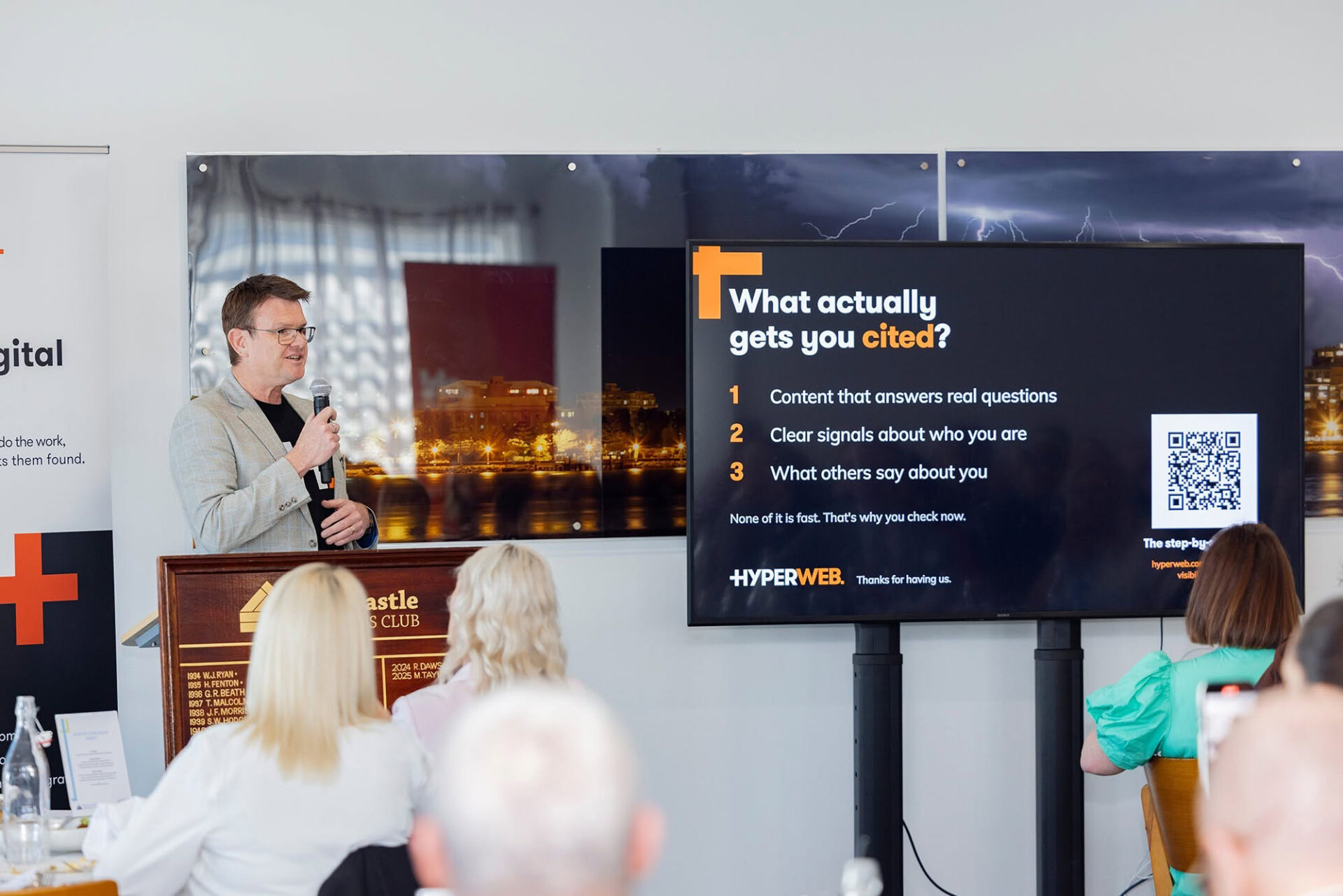
I showed two rooms the same thing in the last month, a Newcastle Business Club lunch and a digital bootcamp out at Tocal. Take a business sitting on page 1 of Google. Ask ChatGPT the question that business’s customers would actually ask. Watch it name three other businesses and never mention them.
The room goes quiet at that point. Most people in it have never checked.
The reason is structural. Google ranks pages and hands you a list to choose from. AI engines assemble an answer, which means they have to decide who to name and who to leave out. They can only name businesses they can find, understand and trust, and those three things come from how your site is built, whether your business details are consistent everywhere they appear, and whether you’re mentioned credibly beyond your own website. Ranking well helps. It isn’t the same job. We pulled apart the five common reasons a business gets skipped in why ChatGPT recommends your competitors and not you.
The useful part for a business owner is that this is measurable. Ask the engines the questions your customers ask, logged out so you’re seeing what a stranger sees, and note who gets named. That’s your baseline, and it takes about half an hour. We wrote the method up in how to check where you really stand if you’d rather run it yourself.
Google ranks pages and hands you a list. AI engines assemble an answer, which means they have to decide who to name and who to leave out.
Where could AI do real work inside your business?
The second bucket emerges differently, organically. More and more clients are realising that AI capabilities can solve a pain point in their systems and processes. It usually starts with something specific: the admin that eats a day a week, the quoting process that lives across three spreadsheets and one person’s memory, or the software subscription that costs thousands a year and does maybe a third of what the business actually needs.
Those are good starting points, because they’re specific and they already have a cost attached. Vague AI ambitions go nowhere. A named process that wastes a named amount of time is something you can put a number against and either fix or leave alone on purpose.
Three questions are worth asking about any process you’re considering. How often does it happen? How much of it is judgment and how much is moving information from one place to another? And what would getting that time back actually be worth? Work that’s high frequency and low judgment is where AI earns its keep first. Work that needs someone to weigh things up stays with a person, ideally with better information in front of them. We’ve written up the full process in could AI replace the software you’re paying for.
Can a bespoke application replace expensive off-the-shelf software?
Often, yes. It’s also the question the fewest people think to ask.
Off-the-shelf software is built for the average of thousands of businesses. You pay for the whole product, use the slice that fits, and bend your own process around the parts that don’t. Per seat, per month, indefinitely.
A bespoke application works the other way around. It’s built around how you actually operate, it does the things you need and nothing else, and you own it.
It isn’t automatically the right answer. If the off-the-shelf product fits and the price is fair, keep it. The test is the gap between what you’re paying for and what you actually use, plus how much of your process you’ve had to distort to suit the tool. When that gap is wide and the subscription is well into five figures a year, it’s worth costing the alternative properly. AI has moved that maths, because building software specific to one business is meaningfully cheaper than it was three years ago.
What does an AI readiness review cover?
Two halves, matching the two buckets.
Where you appear to your customers:
- How your business is named across ChatGPT, Perplexity and Google’s AI, on the questions your customers actually ask
- Who’s being named instead, and what they’re doing that you aren’t
- The technical reasons you’re being skipped: content structure, schema markup, crawler access, and whether your business details are consistent across the web
- What to fix first, and what can wait
Where AI could do the work:
- A look at your systems and processes, and where the repeat work actually sits
- What your current software costs measured against how much of it you use
- Where a bespoke application would pay for itself, and where it plainly wouldn’t
- A short list of what’s worth starting now against what’s better left for twelve months
You get a written summary either way. Some businesses take that list and hand it to their own people, and that’s a perfectly good outcome.
What have we learned running this on ourselves?
We’ve spent the last three years doing this to our own business first, riding the heavy wave of AI change and trying to stay just under the lip. Plenty of what we tried didn’t stick.
Two things have remained consistent. The first is that the tools change every few months, so the useful skill isn’t picking the right tool, it’s being able to swap tools without rebuilding how your business runs. The second is that the businesses getting real value started with a problem, not with the technology. The ones who started with the technology mostly ended up with a subscription and a story.
We’ve started doing the same for clients, and we’re set up to help more.
Frequently asked questions
What is an AI readiness review?
It’s an assessment of two things: how visible your business is in AI search across ChatGPT, Perplexity and Google’s AI, and where AI could do useful work inside your systems and processes. The first half looks at why you are or aren’t being named when customers ask AI engines for a business like yours. The second half looks at repeat work, current software costs, and whether a bespoke application would serve you better than an off-the-shelf subscription. You get a written summary with what’s worth fixing first.
Isn’t AI search visibility just SEO with a new name?
They overlap heavily, and good SEO work makes AI visibility easier. The difference is the finish line. Google shows a list of links and lets the customer choose. An AI engine assembles a single answer and names a handful of businesses, so being one of the options is a different result from ranking well. Content structure, schema markup, consistent business information and crawler access all matter more when there’s only room for three names.
How do I know if a custom application is worth building instead of paying a subscription?
Compare what you’re paying for against what you actually use, and count how much of your own process you’ve reshaped to suit the software. If you use most of the product and it fits how you work, stay where you are. If you’re paying well into five figures a year for a fraction of the features, working around the gaps manually, and adding staff time to make it fit, it’s worth costing a bespoke build properly. Building software around one business is cheaper than it was three years ago, which has changed where that line sits.
Is my business too small for any of this?
No. The AI search side matters more for small businesses, not less, because an AI answer names three businesses where a Google results page shows ten. On the process side, the starting point isn’t a large project. It’s usually one repetitive task that eats a predictable amount of time each week. Small businesses often see the value faster because there are fewer people and systems to change.
Want to know where your business stands?
HyperWeb has been building websites and digital strategy for Newcastle and Hunter businesses since 2000, and both halves of this are now part of that work. If you’d like to know where you stand on either front, being found or getting the work done, book an AI readiness review below or get in touch with the team.
If you’d rather read first, our working guide to GEO and AEO covers the search side in full, and our AI and application integration page covers the build side.