Ask most business owners what CRM integration means and you will get a tidy answer: install a plugin, connect two apps, flip a switch, you are done. That picture is understandable, and it is also why so many integrations quietly fall apart about six months in.
A real integration is not a plugin, it is a business-systems job. The harder questions are which system holds the truth when two of them disagree, how your business actually works (not just which fields line up), how data stays in sync as it changes, and how the messy edge cases the brochure never mentions are going to be handled. Get those right and the website ends up doing more useful work than almost anything else in the business. Skip them and the cracks show up later, usually first to a customer rather than to you. We hit the same idea when we asked whether you could just get AI to build your website: the finished surface can look identical, while what sits under it either holds up for years or quietly costs you for years.
A real integration is not a plugin, it is a business-systems job.
Few projects illustrate this better than the website we built for Eclipse Travel, so it is worth walking through what integration really involves using a real build as the guide.
So what does CRM integration actually mean?
Eclipse Travel is a premium agency that designs tailor-made itineraries to some of the most remote places on earth: Africa, Antarctica and South America. Two systems ran their business behind the scenes. A custom-built CRM held customer relationships and enquiries. A separate system called Tripeze handled the trip catalogue, with the itineraries, pricing and availability.
Because the CRM had been built for Eclipse rather than bought off the shelf, there was no connector to download and no plug-and-play option to fall back on. Before we wrote a line of integration code, we had to sit with their system and learn how it actually worked. Hilary Dubyk, their General Manager, put the challenge plainly:
“Eclipse uses a custom-built CRM that wasn’t designed as an off-the-shelf platform, so there was no simple plug-and-play solution available. HyperWeb embraced the challenge with enthusiasm, took the time to understand how our CRM worked, and developed a seamless integration between the website and our internal systems.”
Hilary Dubyk, General Manager, Eclipse Travel
The new website had to do more than sit alongside those systems looking nice. It had to operate as part of them, reading from each one and writing back into the right place. That is what we mean by integration in practice: a website that reads from and writes to the systems your team already relies on, so the work happens once and ends up everywhere it needs to be.
Why does a single source of truth matter so much?
Every integration has to answer a question that sounds simple and is not: when two systems disagree, which one wins?
If a package price lives in Tripeze and also on the website and the two disagree, which one is right? If a customer updates their details, where does that change belong? Without a clear answer, you end up with two versions of reality and a team that does not trust either.
For Eclipse, we agreed early on which system was the authority for each kind of data. Their package management system was the source of truth for packages. The CRM was the source of truth for customer relationships. The website became the shop window that reflected both accurately, rather than a third version of the same data that would inevitably drift away from the others. That one decision is what stops the slow data drift that quietly undermines most integrations a year or two in.
Isn’t it just a matter of mapping the fields?
This is where cheap integrations and serious ones diverge.
Connecting fields is the easy bit. This box maps to that box. But businesses do not run on fields, they run on logic. A premium travel package is not just a number in a price field. It carries seasonal variation, availability windows, special-interest categories, tour styles, and rules about what can be shown to whom and when. Getting all of that into a website properly means understanding how the business actually works, not just where each piece of data sits in the database.
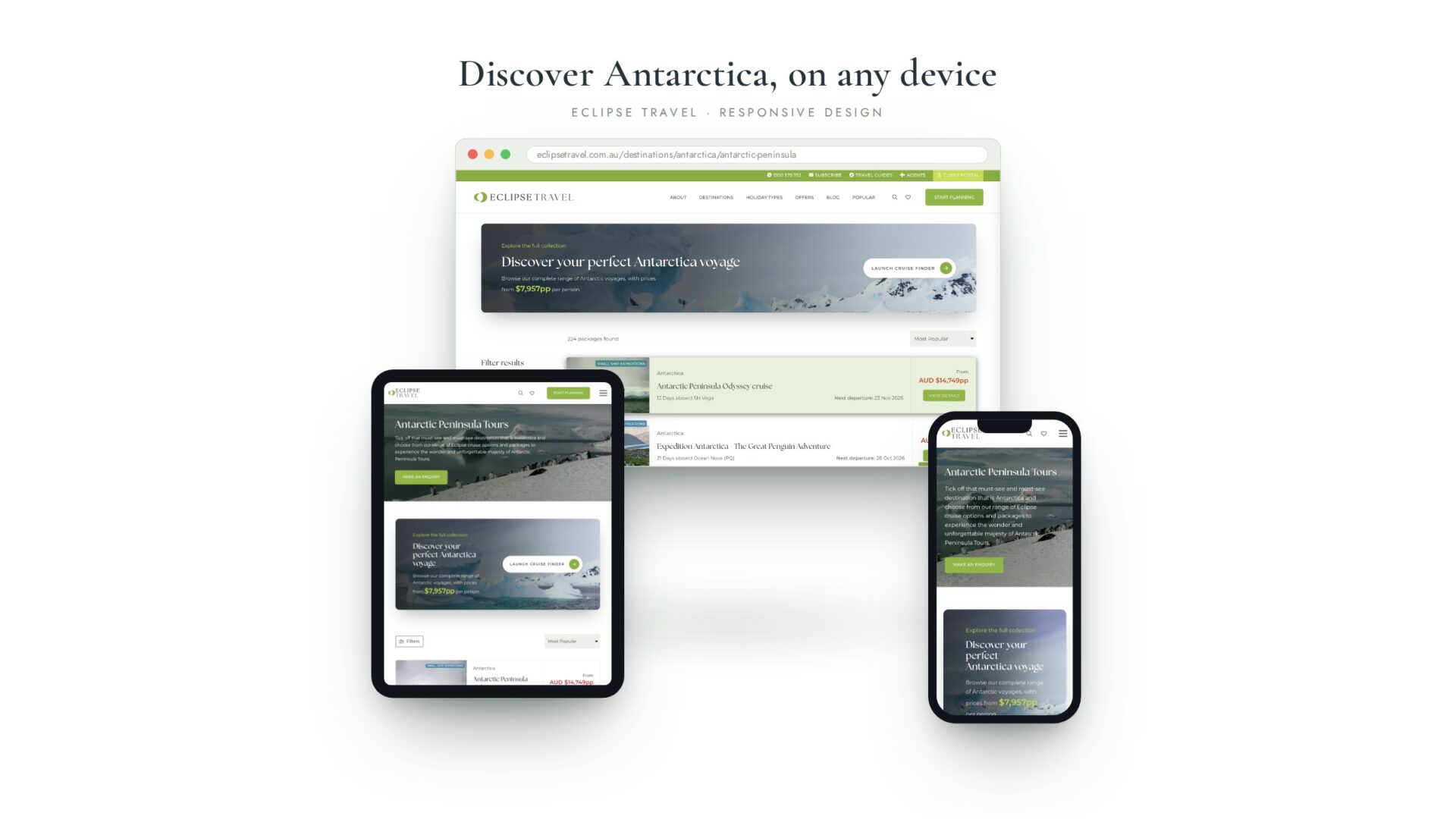
For Eclipse, that meant building the filtering on the website so travellers could sort by destination, budget, special interest or tour style, and have the results behave the way the business behaves. Their Sales and Marketing Director described the customer-side outcome this way:
“The new website allows clients to filter options by destination, budget, tour style, and special interests, providing a much more premium and intuitive user experience.”
Hilary Dubyk, General Manager, Eclipse Travel
What sits underneath that customer experience is weeks of work mapping real business logic into working code.
What is the part everyone underestimates?
Real-time sync. Most people moving an integration from spec to live get caught by surprise here.
Moving data once is easy. What is hard is keeping data accurate as it changes, continuously, without anyone touching it. When a package changes in Tripeze, the website needs to reflect that change. When an enquiry comes through the site, it needs to land in the CRM straight away and attach to the right record.
Eclipse’s setup showed exactly how this bites. Tripeze kept its own cache that expired every 24 hours. The problem was what happened on expiry. If a customer loaded a page with out-of-date data, the system went off to fetch fresh data right then, while that customer sat and waited. On a catalogue of more than 1,000 packages, that meant real visitors were paying the load-time cost for a refresh the system should have been handling quietly in the background. Slow pages are also an SEO problem, because Google treats page speed as a ranking factor, so the cache was costing Eclipse on both fronts at once.
We did not rebuild Tripeze from the ground up. We built a wrapper around it: a layer that reshaped its data into a cleaner, more flexible format and swapped the blocking cache for a non-blocking one. The page now serves instantly from the cache while fresh data loads in the background. The customer never waits on a fetch. That is what real-time sync is supposed to mean in practice, and it is usually the thing that decides whether an integration just runs in the background or makes work for everyone using it.
What changes when you are running 1,000+ packages?
Most integrations look fine with ten records. The interesting failures show up at scale.
Eclipse needed an architecture that handled more than 1,000 travel packages and let filtering stay fast as the catalogue grew. That is a meaningfully different engineering problem from a small brochure site. It changes how data is queried, how it is cached, how it is indexed, and how the site behaves when a visitor narrows 1,000 options down to the handful that suit them.
On a premium site, performance is part of the product. A travel agency selling once-in-a-lifetime trips cannot afford a sluggish or clunky search. The experience has to feel as considered as the itineraries on offer.
What about the things that go wrong?
Every serious integration has to answer an uncomfortable question. What happens when the connection fails? Systems go down, connections time out, package updates arrive half-formed. What separates a well-built integration from a flaky one is how those moments are handled. Does the site show a broken page, or does it fail gracefully and recover on its own? Does a dropped sync get retried automatically, or vanish silently and leave your data wrong?
Designing for those edge cases (the unusual, the malformed, the moment of failure) is unglamorous work that never makes it into a sales demo. It is also the work that determines whether the integration still feels trustworthy a year later, and it is usually the work that gets skipped when an integration is sold to you as a plugin.
Who runs all this once the build is done?
If the people running the business cannot operate the integration once it is built, the work is not actually finished. For Eclipse, the build included proper quality assurance and user training, so their team could manage packages, content and customer data with confidence. A system only earns its keep if the people using it understand how it works and trust what it tells them.
The work also does not stop at launch. Business logic shifts. Products change. Supporting systems get upgraded behind the scenes. An integration is a living part of the business that needs occasional attention, in the same way as any other piece of infrastructure your revenue depends on.
The integration dividend
Here is what all that work actually buys you.
Manual double-entry goes away because the systems talk to each other. Customer information becomes reliable because there is a single source of truth. The booking path flows instead of stalling at every step. The website stops being a separate island and starts behaving like the most productive system in the business, reflecting how the operation actually runs in real time.
For Eclipse Travel, the result was a smoother booking journey and a digital presence that lined up with the kind of trips they sell. The numbers since the new site went live at the start of 2025 are worth quoting. Comparing 2025 to 2024, total enquiries rose from 19,134 to 29,287, a 53% increase year on year, and gross new sales grew from $24.4 million to $32.1 million, up $7.7 million or 31.5%.
A website project never deserves sole credit for growth at that scale, and Hilary is the first to say so. But she also points to a real change in how the brand is experienced day to day. The site feels more professional. The navigation is much clearer. The CRM integration has noticeably streamlined the enquiry process. That is what a well-executed integration tends to look like in practice, and it is roughly the difference between a build that earns its budget back and one that quietly costs the business for years.
When someone pitches CRM integration as just a plugin, they are mostly telling you how their last few integrations have ended. If you would rather build the kind that becomes the most productive system in your business, that is the work we do, and you can see more of our builds here. For a platform-level version of the same question, see WooCommerce or Commerce7 for winery websites.
Frequently asked questions
What is the difference between connecting two apps and real CRM integration?
Connecting two apps usually means a one-way handoff. Data passes from one place to another and the job is considered done. A real integration is continuous and two-way. It involves deciding which system owns each piece of data, mapping the business logic rather than just matching field names, and keeping everything in sync as data changes. The first is a plumbing job. The second is a business-systems decision that changes how the whole operation runs online.
What is a single source of truth and why does it matter?
A single source of truth is the system you have decided is the authority for a given type of data, so that when two systems disagree there is a clear answer about which is right. Without one, your website, CRM and other tools tend to drift apart over time, and your team is left unsure which figure or detail to trust. Defining it early, as we did for Eclipse Travel (the package system owning packages and the CRM owning customer relationships), prevents the slow data drift that undermines most integrations after a year or two.
How many products or packages can a CRM integration handle?
There is no fixed ceiling, but scale changes the engineering. An integration that works fine with a handful of records can slow to a crawl with thousands if it has not been built for that scale. Eclipse Travel’s site was built to handle more than 1,000 travel packages with fast filtering, which meant making careful decisions about how data was queried, cached and indexed. The number itself matters less than whether the system has been designed to stay fast as the catalogue grows.
Is CRM integration a one-off project or an ongoing commitment?
Both. The initial build is a defined project, but the integration itself is a living part of the business. As products, pricing and supporting systems evolve, the integration needs occasional attention to keep working as intended. Treating it as set-and-forget is one of the most common reasons integrations quietly break in the second year. The better mindset is to treat it as infrastructure that your revenue depends on, and maintain it accordingly.
By Brendan Brooks, Founder and Managing Director of HyperWeb. Brendan has spent 25 years helping businesses turn their websites into working parts of the business rather than separate islands.