
There’s a pattern playing out across Australian businesses right now, and it’s costing them money.
A new AI tool launches. The marketing gets everyone excited. Someone in leadership says, “We should be using this.” A subscription gets purchased. The team gets a login. And then… not much happens.
Six months later, the tool is either abandoned entirely or limping along at a fraction of its potential. The problem wasn’t the technology. The problem was the sequence of decisions that led to adopting it.
Most businesses approach AI adoption backwards. They start with the platform and try to retrofit a purpose. It rarely works, and when it fails, they often conclude that AI “isn’t right for us” or “isn’t mature enough yet.” Neither is true. The approach was wrong.
Most AI initiatives fail, and not because of the technology. They fail because businesses start with the platform instead of the problem.
Where this thinking came from
I was reading an article in Harvard Business Review recently about applying a four-lens framework to sustainability challenges. It struck me how powerful the approach was: rather than jumping straight to solutions, the framework forced decision-makers to look at the problem from multiple perspectives in sequence.
It got me thinking about the strategic models I studied during my Masters. The best frameworks share a common trait: they slow down decisions just enough to ensure you’re solving the right problem before committing resources to a solution.
Then I made a connection. We’ve all heard of the 5 Ps of Marketing (product, price, place, promotion, people). It’s endured for decades because it gives marketers a simple, memorable structure for thinking through complex decisions. What if there were an equivalent for AI adoption? A framework that could bring the same clarity to a space that’s currently drowning in hype and reactive decision-making?
That’s where the 4 Ps of AI Adoption came from. It’s built around a simple principle that too many businesses are ignoring: technology is the last question you should ask, not the first.
Technology should be the last question you ask, not the first.
The 4P Framework
The framework consists of four lenses, applied in a specific order: Purpose, People, Payoff, and Platform. Each lens must be satisfied before moving to the next. Skip one, and you’re building on an unstable foundation.
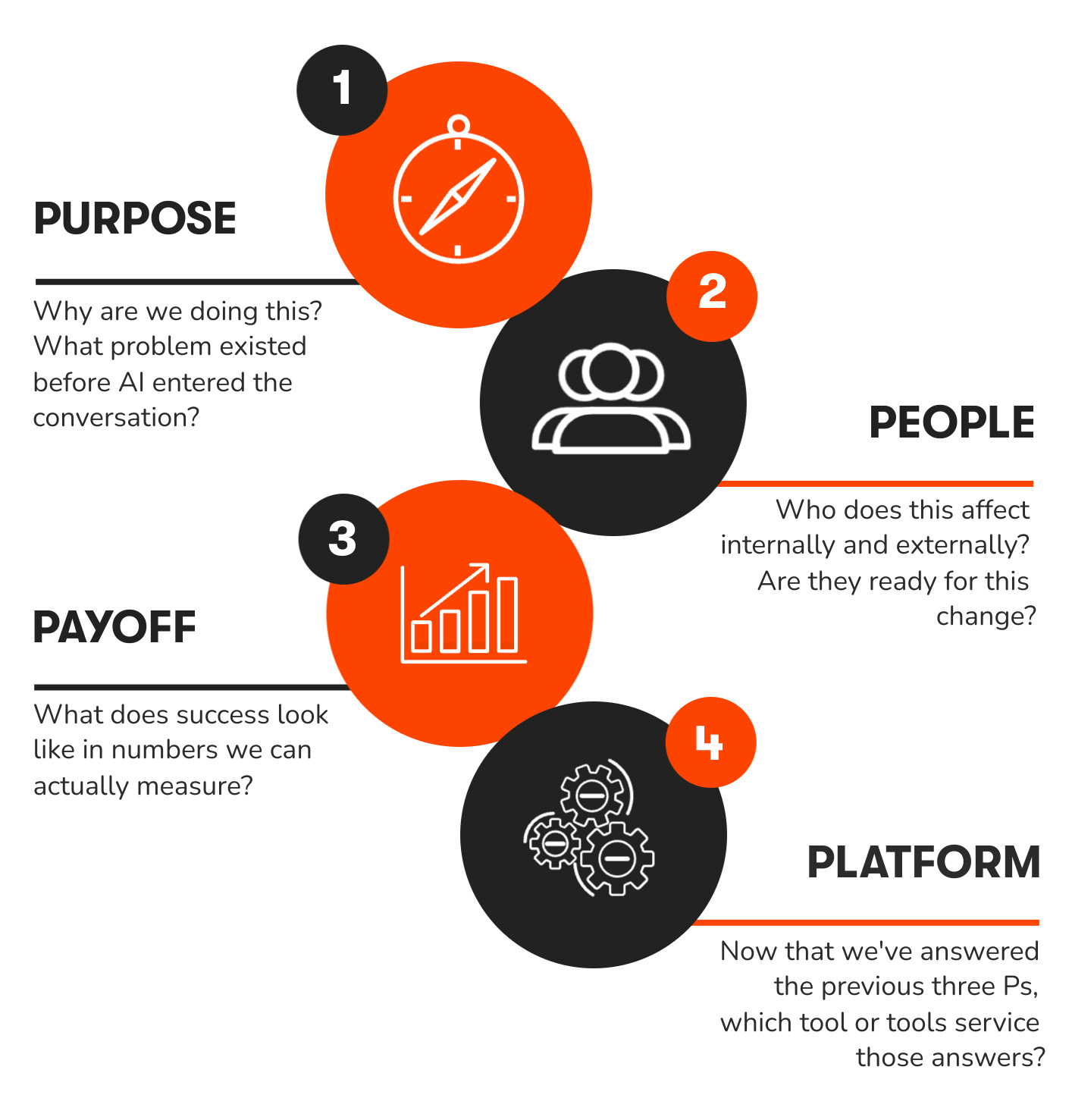
Purpose: Why are we actually doing this?
This sounds obvious, but it’s where most AI adoption falls apart before it begins.
“Because our competitors are using it” is not a purpose. Neither is “because it’s the future” or “because we don’t want to fall behind.” These are reactions to external pressure, not strategic intent.
A genuine purpose connects AI adoption to a specific business challenge or opportunity you’ve already identified. You’re not adopting AI and then looking for problems to solve. You’re solving a defined problem and evaluating whether AI is the right approach.
Strong purposes sound like this: “We’re losing qualified leads because our response time outside business hours is too slow.” Or: “Our team is spending twelve hours a week on content production tasks that don’t require human judgment.” Or: “Customers are abandoning our quote request process because it requires too much manual input.”
Each of these statements existed before AI entered the conversation. The technology becomes a potential solution to a problem you were already committed to solving.
When businesses skip this step, they end up with AI tools wandering around looking for a job to do. The team isn’t invested because there’s no clear problem being solved. Leadership can’t measure success because success was never defined. And when renewal time comes, no one can articulate why the subscription should continue.
People: Who does this affect, and are they ready?
AI adoption is a change management exercise disguised as a technology decision.
Every AI implementation affects people. Sometimes it’s your team, whose daily workflows will shift. Sometimes it’s your customers, whose experience of your business will change. Often it’s both. Ignoring this lens is how businesses end up with technically successful implementations that fail in practice.
Start with your team. Who will actually use this tool? Do they understand why it’s being introduced? Do they have the capacity to learn something new right now, or are they already stretched thin? Have they been consulted, or is this being imposed on them?
Resistance to AI adoption or concealing it’s use is rarely about the technology itself. It’s about people feeling replaced, overlooked, or burdened with additional complexity during an already demanding workload. Address these concerns before implementation, not after.
Then consider your customers. If AI is going to touch their experience, how will they perceive it? Customers have become increasingly sophisticated at detecting automated interactions. Some welcome the efficiency. Others feel fobbed off. Your approach needs to account for your specific audience’s expectations.
The businesses getting this right are involving their teams early, being transparent about what AI will and won’t do, and creating feedback loops so implementation can be refined based on real experience rather than assumptions.
AI adoption is a change-management exercise disguised as a technology decision.
Payoff: What does success actually look like?
Here’s where strategic discipline separates genuine adoption from expensive experimentation.
Before any platform is selected, you should be able to articulate exactly what success looks like in terms you can measure. Not vague improvements. Specific outcomes with numbers attached.
“We want to improve efficiency” means nothing. “We want to reduce our average lead response time from four hours to fifteen minutes” is something you can actually track. “We want better content” is immeasurable. “We want to increase our blog publishing frequency from two posts per month to six without adding headcount”, gives you a clear target.
This lens forces honesty. When you have to define the payoff upfront, you quickly discover whether your expectations are realistic. You also create the accountability that ensures AI adoption gets the ongoing attention it needs rather than fading into the background.
The payoff you define should connect directly to your purpose. If your purpose was solving slow lead response times, your payoff metrics should measure response time improvements and their downstream effects on conversion rates. If your purpose was reducing time spent on repetitive content tasks, your payoff should quantify the time saved and how that capacity was redeployed.
Without this lens, AI becomes a cost centre with no clear return. With it, you have a business case that can be evaluated, refined, and scaled.
If you can’t measure the payoff, you can’t justify the platform.
Platform: What’s the right tool for the job we’ve defined?
Only now, with Purpose, People, and Payoff clearly established, does technology enter the conversation.
Notice what’s different about the question at this stage. You’re not asking “what can this AI tool do?” You’re asking, “Which tool best serves the specific purpose we’ve defined, for the people who’ll use it, with the payoff we need to achieve?”
This reframes vendor evaluation entirely. Features that seemed impressive in a demo become irrelevant if they don’t serve your defined purpose. Tools that looked simple might reveal hidden complexity when you consider the people who’ll actually use them. Pricing that seemed reasonable might not stack up against the specific payoff you need to justify the investment.
You’re also better equipped to resist the considerable marketing pressure around AI tools. When a vendor promises transformative results, you can ask specific questions: “How does this address our particular purpose? What’s the learning curve for our team? Can you show me evidence of the payoff we’re targeting?”
The platform decision, made at the end of this sequence, is dramatically more likely to succeed than one made at the beginning. You’re choosing technology to fit a clearly defined job rather than hoping a job emerges to justify the technology.
Putting the framework into practice
If you’re currently evaluating AI adoption for your marketing or website operations, work through these four questions in order:
- What specific problem are we trying to solve, and did this problem exist before AI entered the conversation? That’s your Purpose.
- Who will this affect internally and externally, and what do we need to address to bring them along? That’s your People.
- What measurable outcome would make this investment worthwhile, and how will we track it? That’s your Payoff.
- And only then: which tool best serves the answers we’ve just defined? That’s your Platform.
If you find yourself struggling to answer any of the first three questions clearly, that’s valuable information. It suggests you’re not yet ready to make a platform decision, and making one anyway is how AI investments underperform.
AI adoption doesn’t stop at implementation.
There’s a broader context worth considering here. AI isn’t just changing how businesses operate internally. It’s fundamentally reshaping how customers find and evaluate businesses online.
Search is evolving. Google’s AI Overviews, ChatGPT’s search capabilities, and other generative AI tools are changing the way people discover information. The businesses that thrive won’t just be adopting AI behind the scenes; they’ll be positioning themselves to be found and recommended by AI systems.
This is where Generative Engine Optimisation comes in. Traditional SEO focused on ranking in search results. GEO focuses on being the answer that AI systems reference and recommend. It’s not a replacement for SEO; it’s the next layer of visibility strategy that forward-thinking businesses need to address.
The 4P Framework applies here, too. Before jumping into GEO tactics, you need a clear purpose (what do we want to be known for?), an understanding of your people (what questions are our customers asking AI systems?), a defined payoff (how will we measure increased AI-driven visibility?), and only then the platform decisions (what content and technical changes will get us there?).
AI isn’t just changing how you operate. It’s changing how customers find you.
The competitive advantage of getting this right
The businesses that will win in the next few years aren’t necessarily the ones adopting AI fastest. They’re the ones adopting it most strategically.
While competitors chase every new tool announcement and accumulate subscriptions they barely use, businesses following a disciplined framework are building genuine operational advantages. They’re solving real problems, bringing their teams along, measuring actual results, and choosing technology that serves defined needs.
The difference compounds over time. Strategic adopters learn what works for their specific business. Reactive adopters learn only that AI is complicated and expensive.
The 4P Framework isn’t about slowing down AI adoption. It’s about ensuring the adoption you pursue actually delivers. Purpose before platform. Every time.
The businesses that win won’t be the fastest adopters, they’ll be the most strategic.
Where to from here?
If you’re ready to apply the 4P Framework to your business but want guidance working through it, that’s exactly what our HyperAI consulting service is designed for. We help Australian businesses cut through the noise, identify where AI can genuinely add value, and implement solutions that your team will actually use.
And if you’re thinking about how AI is changing the way customers find you online, our GEO services can help you build visibility in the new AI-driven search landscape before your competitors figure it out.
Get in touch to discuss your AI strategy or Learn more about GEO and what it means for your business.
Strategic AI adoption isn’t about going slower, it’s about getting it right.