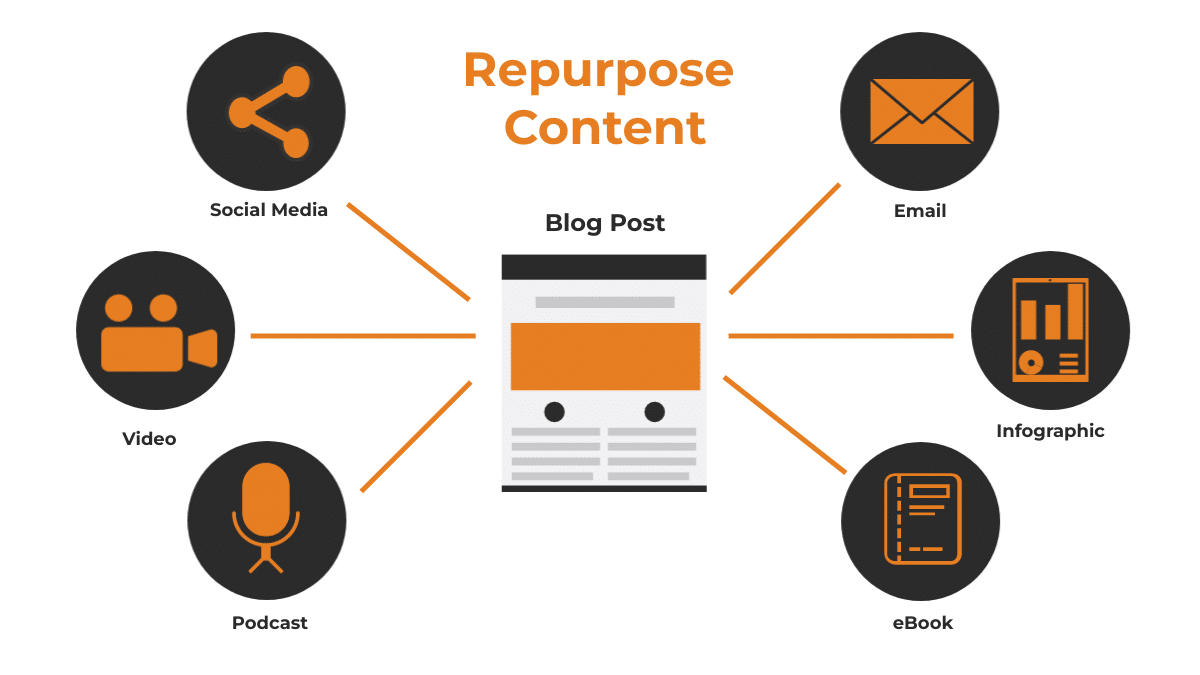
Content repurposing means taking one piece of work you have already produced and reshaping it into new formats for new places, so a single blog post becomes a video, an email, five social posts and a section of a landing page. Done well, it lets a small team publish like a big one. In 2026, with AI able to do much of the reshaping and with AI search rewarding brands that show up consistently across formats, it has gone from a nice-to-have to one of the highest-return habits in marketing.
Most businesses do not have a content problem. They have a distribution problem. You have already written the blog posts, answered the same client questions a hundred times, and built up case studies and testimonials. Repurposing is about getting far more mileage out of that existing work rather than always starting from a blank page.
What does repurposing content actually mean?
Repurposing is transforming work you have already done into a different format, for a different channel or a different stage of the buyer’s journey, using information you already have. It is not the same as reposting (sharing the identical thing again) or plagiarising (using someone else’s work). You are taking your own material and adapting it so it works somewhere new.
A single detailed blog post is the classic example. Inside it there is usually enough for a short video, an email to your list, a handful of social posts, an infographic, and a talking point for a sales conversation. The thinking is already done. Repurposing is mostly reshaping and reformatting.
Why repurpose instead of always creating new?
Four reasons, and they compound.
Reach. Your audience is scattered across channels and formats. Someone who will never read a 1,500-word article will happily watch a 60-second video or skim an infographic. Repurposing puts the same idea in front of people the original format was never going to reach.
Reinforcement. People rarely act the first time they see a message. Seeing the same idea as a post, then an email, then a video builds familiarity and trust in a way one touch never will.
Search and AI visibility. Consistent, multi-format coverage of a topic is exactly what signals genuine authority, to Google and increasingly to AI engines like ChatGPT and Perplexity. When your take on a subject shows up as an article, a video and a cited answer, you become the source the algorithms trust. We cover this in depth in our guide to GEO and AEO.
Efficiency. The hardest part of content is the thinking, and repurposing reuses it. One good idea, properly repurposed, can feed a month of publishing. That is the difference between a content program that survives and one that quietly stops.
What AI changes about repurposing in 2026
Two things have shifted, and they pull in the same direction.
First, AI has made the reshaping fast. Turning a blog post into an email draft, a set of social captions or a video script used to be the slow, manual part. A good AI prompt now does the first draft of that in seconds, so the bottleneck moves from production back to having something worth saying. The judgement still has to be yours, but the grunt work is largely gone.
Second, AI search has raised the payoff. When someone asks an AI engine a question, it draws on the brands it has seen cover a topic credibly and repeatedly. A business whose thinking appears as an article, a video transcript and a cited answer is far more likely to be the one named. Repurposing is now one of the most direct ways to earn that.
Ways to repurpose one piece of content
Here are the formats worth having in rotation. You will not use every one for every piece, but a single strong blog post can usually feed most of them.
Video. Every major platform now favours video, and a blog post is a ready-made script. Talk through the key points to camera, or build a simple slide-based explainer. You do not need a studio; a phone and good light will do for social.
Infographic. Pull the key stats, steps or takeaways out of a post and lay them out visually. Infographics travel well on social and in newsletters, and they are easy to skim, which is most of how people consume online.
Email and EDM. Your email list is the audience you actually own. Turn a blog post into a tailored email, or bundle recent articles, a case study and an offer into a monthly newsletter. This is the channel most businesses under-use.
Social posts. One article is several social posts, not one. Pull out individual points, stats or quotes and space them out across the channels that suit your audience. Our thinking on doing this without sounding like a broadcast is in social media management that builds trust.
Podcast or audio. If a post has more in it than the page allowed, talk it out as a podcast episode, solo or with a guest from your industry. Audio reaches people during commutes and workouts that no other format touches.
Lead magnet or ebook. Group several related posts into a downloadable guide. It packages your expertise, gives people a reason to join your list, and doubles as a sales asset.
Website pages. Content that performs on social or in email often deserves a permanent home. Turn a strong social thread into a blog article, or a recurring client question into a service-page section or FAQ, where it can rank and get cited for years.
Testimonials and results. Genuine client feedback is content. Turn a great testimonial into a social graphic, a case study, or a line of proof on a landing page.
Data and reports. If you sit on analytics or industry data, turn it into readable tips, fun facts or a short “what the numbers say” post. Original data is some of the most linkable and citable content there is.
Refresh the old. The easiest repurposing of all is updating what you have. An article that still ranks but has dated details often needs an update, not a replacement. Refreshing existing content is frequently a better return than writing something new, and this very page is an example of it.
A simple repurposing workflow
You do not need a complicated system. The businesses that repurpose well tend to follow the same rough loop.
Start with a pillar: one substantial piece on a topic that matters to your customers. Break it into parts, so each key point becomes a candidate for its own format. Adapt each part to the channel rather than copying and pasting it, because a good social post and a good email read differently. Then schedule the pieces out over weeks rather than dumping them all at once. One pillar can comfortably fill a month.
Common mistakes to avoid
Repurposing goes wrong in a few predictable ways. Copying the identical text into every channel is the most common; each format has its own rhythm and a straight paste reads as lazy on at least one of them. Repurposing weak content is another; reshaping something that did not land the first time just spreads the problem. And forgetting the call to action is easy to do when you are focused on reformatting, so every repurposed piece should still point somewhere useful.
Frequently asked questions
What does it mean to repurpose content?
Repurposing content means taking something you have already produced, such as a blog post, and reshaping it into a different format or for a different channel, such as a video, an email, a set of social posts or an infographic. You are reusing your own thinking and information in a new form, which is different from simply reposting the same thing again.
Is repurposing content good for SEO?
Yes. Covering a topic consistently across formats signals genuine authority to search engines, and updating or expanding existing content that already ranks is one of the highest-return SEO activities there is. Repurposing also increasingly helps with AI search, because engines like ChatGPT and Perplexity favour brands that appear credibly and repeatedly on a subject.
How often should I repurpose content?
Treat repurposing as the default rather than the exception. A practical rhythm is to build one substantial pillar piece, then repurpose it into several smaller formats spread over the following weeks. One strong piece can usually feed a month of publishing across your channels.
Can AI help me repurpose content?
Yes, and it is one of the most useful things AI does for marketing. AI can quickly draft an email, social captions or a video script from an existing blog post, which removes most of the manual reformatting work. The judgement about what is worth saying and whether it sounds like you still has to be human, but the grunt work is largely automated.
Want help building a content engine that actually runs?
Repurposing is simple in theory and easy to let slide in practice. HyperWeb has helped Newcastle and Hunter businesses build content and marketing programs that keep running since 2000. If you would like a hand turning the work you have already done into a steady stream of content, get in touch with the team. Our pieces on why business blogging still matters and optimising for AI search are good next reads.